
 EN
EN



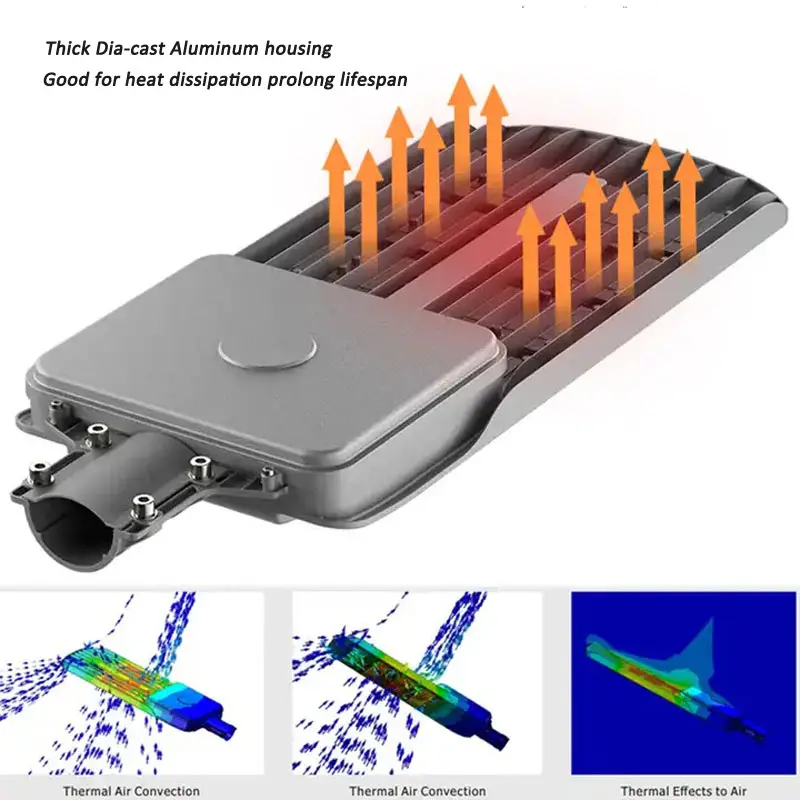
Solar Street Light Height and How It Impacts Illumination Performance
The Inverse-Square Law
An example of the inverse square law is in the case of a light pole being twice the height of a standard pole. The illumination at ground level will be reduce by approximately 75%. For instance, a solar street light placed at 6 meters is expected to produce only 1/4 of the light illumination at the ground level as opposed to a light placed at with a height of 3 meters. This is usually the main factor when determining how high a light pole should be as it pertains to the width of a road. Generally speaking, people adopt a 1-to-1 approach. Using the example of the Indian standard 3500, a 7-meter road will require a light pole of the same height in order to achieve a uniform illumination of above 20 lux. Glare is a serious problem when the mounting height of a light is low. It is also a problem when the light is adjusted horizontally in the direction of the light. Higher poles are more effective at reducing glare, and properly designed lights will get a greater percentage of the light to where it is needed. More energy will be used to produce less visible light than to produce more visible light with a high level of power consumption.
Height vs. Wattage: Why Height Matters for Solar Street Lights
Increased height gives the lamps a better spread of light than increasing wattage. In our case, increasing length from 4 meters to 8 meters almost tripled the area without increasing the power. This is a prime example of positioning vs the bulb's wattage. This has been proven in the field in Gujarat as well; 12 meter street light poles used 25% less energy to cover ~40% more than the 8 meter poles. Higher panels mean less surrounding shadow-creating obstructions which helps collect about 18% more energy throughout the day. Most engineers know this, which is why they focus on height rather than battery-power for systems which cost ~$120 more per unit. It is all about the height where systems optimize light distribution, solar capture, wind load, and system longevity.
Contextual Optimal Height for Solar Street Lamp Poles
The height of solar street lights is determined by where the technological solution meets surrounding context. The following are guidelines based on use case.
Residential/Parks (3-6m): For pathways less than 7m wide, 3-6m poles equipped with 30-60W fixtures provide average illuminance of 15-20 lux. This offers reasonable restriction on light spill while comfortably illuminating the pedestrian zone.
Urban Roads (8-10m): For streets that are 8-12m wide with a 30 lux requirement, pair 100W lamps with 8-10m heights. Opposite side installations also improve coverage efficiency and reduce spacing needs.
Highways (10-14m): For 20m+ carriageways requiring high visibility, 10-14m poles with 100-200W units are suitable and can be spaced 40-50m apart to reduce glare and spill light.
A Luxman study (2023) proved that in the case of height deviations of less than ±1.5m, the light output was either 40% less and the energy was wasted by 35%, demonstrating the importance of careful height selection to maximize photometric performance and reduce the life cycle cost.
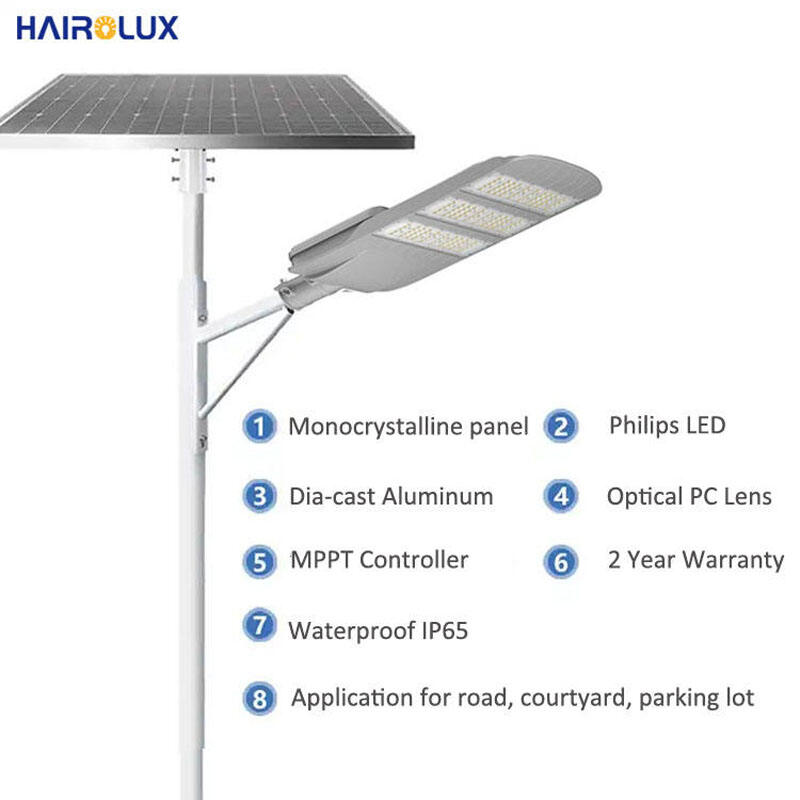
Selecting the Height of Solar Street Lights
Considering the Width of Roads, Height of Street Lights, and Spacing of Lights
Meeting the required light levels across roads is a perfect balance of three elements - the width of the road, the height of the poles and the spacings between poles. For instance, a narrow pathway of about 3 to 4 meters, would need poles of approximately the same height (about 3 to 4 meters) spaced approximately 10 to 15 meters apart to avoid the dreaded dark spot between lights. When it comes to wider roads, say 8 to 12 meters wide, the height and the spacing of the poles changes significantly. The poles would need to be 8 to 10 meters high, and spaced anywhere between 25 to 30 meters. This configuration generally meets the IES RP-8 guidelines. The mathematics ensures that we meet the obligatory requirements of brightness, while limiting glare and light trespass to adjacent properties.
There are trade-offs between solar panel efficiency, wind loading, and panel height.
Wind loads increase with height, which makes the poles need to be built with good materials (i.e., galvanized steel) for wind speeds of ~150 km/h. The good point is that increased height for poles gives solar panels improved sunlight access without obstructions from shading from surrounding buildings or trees. For designers and engineers, there is always a trade-off to be considered. Based on field reports received in 2023, for increased height, the material cost increases by about 18% and the energy production increases by about 9% per day. While PWM controllers manage partial shade issues, they still cannot be fully compensated for the height that is too high. The longer the wires, the more power losses. Mounting becomes more complicated, and the angle may be too flat to gain good solar exposure.
From Standards Documentation to Field Data Verification: IS 3500
Compliance with IES RP-8 and IS 3500 Lux Requirements for All Classes of Roads
When it comes to IES RP-8 and India’s IS 3500 conformity, the height of the solar street lamp is one of the biggest influencing factors for achieving the standards. Some examples include:
- Residential lanes (Width: ₹5m): 6m poles give 10 - 15 lux
- Collector roads (Width: 7 - 10m): 8m poles can meet the 20lux minimum required by IS 3500
- Highways (Width: 12m and Above): Poles 10m & above ensure uniformity of ≥30 lux which is needed for safe travel at high speed
Low heights can create noncompliant dark zones, while excessive heights may lead to non uniformity and wastage of energy. A recent audit (2023) for Gujarat identified 22% non-compliance on the village roads because of the IS 3500’s 10 lux minimum which was not met by poles above 6m. This emphasizes the significance of adequate road and street furniture design.
Field Evidence: 8m vs. 12m Poles on a 7m-Wide Rural Road in Gujarat, India
12-month trial was conducted evaluating pole heights on a 7m roadway.
Even if the 8 meter pole was giving a positive brighter spot here and there, the 12 meter setup, when looking from the average lux and the even spread of light in the roadway, was definitely the best having a score of 0.68 against 0.41 of the shorter pole. Less strain will definitely be felt by the driver along the road and less light will be spilling off into the adjoining fields, better fitting the Indian Dark Sky standards. Considering all of this, we learned that in the setting of solar street lights, good coverage is of the utmost importance and is better than high lux. Uniformity is the best quality measure compared to just a high lux number.
FAQ
What is the inverse distance square law in regard to solar street lamps?
The inverse distance square law states that when the height of the light pole is doubled, the ground illumination will be reduced to one fourth of the value of the illumination that originally existed and informs the setting of the light poles to the distance.
What makes pole height more valuable than wattage when it comes to solar street lamps?
When it comes to solar street lamps, height is more valuable than wattage because it affects the range of light distribution more than just increasing the wattage. There are examples from Gujarat, India, where adjusting the height of poles led to greater distribution of light and even reductions in electricity consumption.
What are the environments and pole height parameters?
3–6 meter poles are ideal for use in residential and park settings, while in urban roads, poles should be between 8–10 meters high, and on highways, pole heights of 10–14 meters are recommended to achieve adequate illumination that is also energy efficient.
What are the downsides of increasing pole height?
The downsides of increasing pole height are that it may involve greater material costs, increased exposure to wind, and possible energy efficiency and light distribution problems if not properly designed.