
 EN
EN



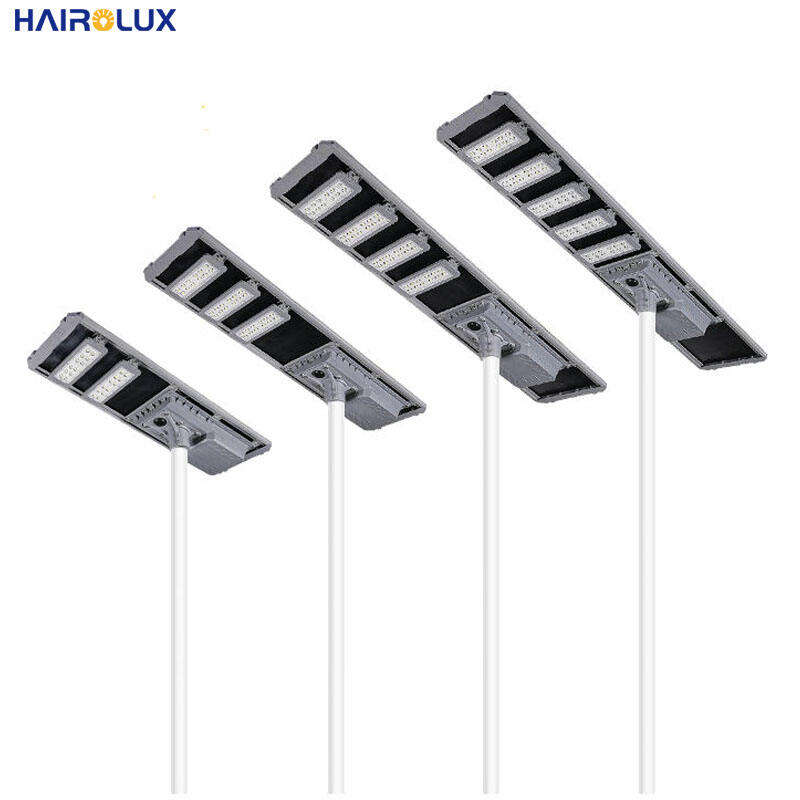
The All-in-One Architecture — What It Eliminates
An integrated solar street light houses the solar panel, LED luminaire, lithium battery, and MPPT charge controller in a single weather-sealed enclosure. This eliminates three things: field wiring between components, trenching for underground cables, and multi-point mounting with separate brackets. The result is a light that mounts to a single pole in under 30 minutes with two workers — versus 3 to 5 hours for a split system.
Zero Field Wiring, Zero Trenching, and Single-Point Mounting
The installation advantage of an integrated solar street light begins before the pole goes up. With no remote panel cable, there is no trench, no conduit, no junction box, and no voltage-drop calculation. On 100 poles, trenching alone adds €8,000 to €15,000 before a single light operates. The single-point mount means one bracket. On-site, a two-person crew lifts the fixture, tightens 4 to 6 bolts. Commissioning is pressing the power button — the MPPT controller, BMS, and dimming profile activate automatically.
Real-World Case — A Municipality Installs 400 Units on a Mountain Road
A municipal government in a mountainous region of Latin America needed to light a 22 km rural access road connecting six villages. The road had no grid electricity, and extending utility power would have required 18 km of new overhead lines at an estimated cost of €240,000 — before pole-mounted luminaires. The municipality selected an integrated solar street light solution from HAIROLUX, a professional solar and smart LED lighting manufacturer specializing in industrial and outdoor illumination. Each unit included a 60W LED array, a monocrystalline solar panel, a 384 Wh LiFePO₄ battery, and a microwave motion sensor for adaptive dimming. Installation was performed by a 6-person crew over 28 working days — averaging 14 poles per day. Trenching was zero. Wiring was zero. The total project cost, including poles and installation labor, came to approximately 40% of the grid extension estimate. The lights have operated through three rainy seasons with zero failures attributed to water ingress, validated by the IP65-rated sealed enclosure.
Installation Time and Labor Comparison
Integrated vs Split-Type — Hours per Pole from Delivery to Commissioning
The labor comparison between an integrated solar street light and a split-type system is quantified in hours per pole. Integrated: 0.5 hours — unbox, lift, bolt, commission. Split-type: 3 to 5 hours — excavate battery pit, pour panel foundation, mount panel and luminaire brackets, install battery box, run and weatherproof cables, test. At €35 per hour, labor savings are €88 to €158 per pole — enough to justify the higher unit price over the project lifecycle.
Site Adaptability and Deployment Flexibility
Slope Terrain, Remote Locations, and Temporary Installations
An integrated solar street light deploys on terrain where split-type systems are impractical. On a slope exceeding 15 degrees, a split system's separate solar panel pole requires a leveled foundation — adding retaining wall or grading work. The integrated unit mounts to a single pole on the slope with no secondary foundation. In remote locations without vehicle access — hiking trails, island footpaths, temporary construction site lighting — the integrated unit ships as a single box under 25 kg that two workers carry by hand. Temporary installations for events, disaster response, or seasonal facilities benefit from the integrated design's portability: install the pole, mount the light, run it for the event duration, and relocate. No decommissioning of underground cables or removal of separate panel structures is required.
Long-Term Maintenance Implications of Integrated Design
Modular Component Replacement and Battery Access Without Rewiring
The maintenance concern about an integrated solar street light is component-level: if the battery or LED driver fails, does the entire fixture require replacement? Modern integrated designs address this with modular internal architecture — the battery pack, LED module, and controller are individually replaceable through an access panel on the underside of the enclosure, secured by tamper-proof screws. Battery replacement takes 10 to 15 minutes with no rewiring — the pack connects via a waterproof plug connector. An integrated unit that requires full-fixture replacement for a battery failure is not a well-designed integrated unit. The LiFePO₄ battery chemistry specified in quality integrated lights delivers 2,000 to 3,000 cycles to 80% capacity, translating to 5 to 8 years of nightly operation before battery replacement is needed.
Frequently Asked Questions
How long does it take to install an integrated solar street light?
An integrated solar street light installs in 25 to 35 minutes with a two-person crew — unbox, lift, bolt, commission. No trenching, no wiring between components, no separate panel mounting. HAIROLUX units ship pre-configured for immediate activation.
Does an integrated solar street light work on cloudy days?
Yes. An integrated solar street light with a properly sized LiFePO₄ battery provides 3 to 5 nights of autonomy at the programmed brightness level, covering consecutive cloudy days. The MPPT charge controller maximizes energy harvest even under diffuse light conditions.
What happens when the battery in an integrated light fails?
The battery in an integrated solar street light with modular design is replaceable through an underside access panel in 10 to 15 minutes. HAIROLUX units use waterproof plug connectors — no rewiring, no soldering.
Can integrated solar lights be installed on uneven terrain?
Yes. An integrated solar street light mounts to a single pole on slopes up to 20 degrees without the secondary panel foundation or retaining wall work that split-type systems require on uneven ground.
What is the lifespan of an integrated solar street light?
An integrated solar street light with an aluminum alloy housing, IP65 sealing, and LiFePO₄ battery lasts 8 to 12 years before major component replacement. Battery replacement occurs at 5 to 8 years depending on usage patterns.
Are integrated solar lights suitable for high-wattage applications?
An integrated solar street light is optimized for 30W to 100W LED output — sufficient for roadway, parking lot, and pathway lighting. Above 100W, the physical size required for solar panel and battery makes split-type systems more practical. HAIROLUX offers both integrated and split-type solutions.