
 EN



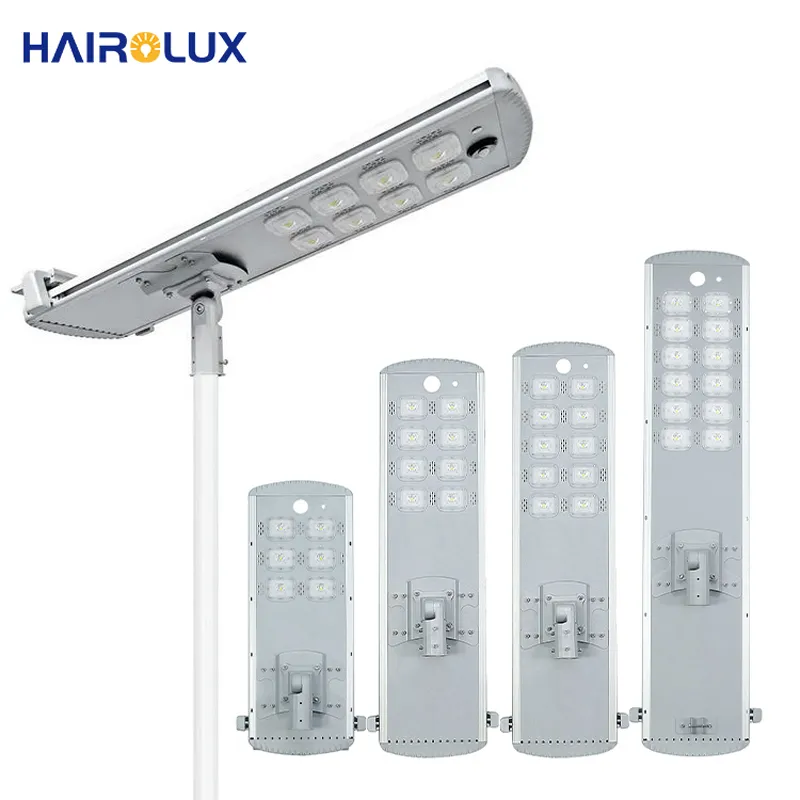
Core Efficiency Drivers of LED Solar Street Lights
Municipal efficiency depends first on how well the LED source converts stored energy into useful road light, and second on how well the fixture and driver protect that performance over time.
LED Luminous Efficacy and Real-World Energy Demand Calculation
High-efficacy LED packages in a well-designed solar street light can reach 180–200 lumens per watt at the chip level, but real-world fixture efficacy—after optical losses, thermal derating, and driver inefficiency—typically falls to 150–170 lm/W. System efficacy is the correct metric for sizing because it directly determines required solar generation and battery storage. Demand calculation starts with the IESNA RP-8–specified maintained illuminance or luminance, multiplied by roadway area. That value is then divided by system efficacy (luminaire × driver × battery round-trip efficiency) to yield the daily energy load in watt-hours.
For example: a 7,500-lumen output at 150 lm/W corresponds to a 50 W LED load. With a 10-hour operating schedule—including five hours dimmed to 70%—daily consumption drops from 500 Wh to 425 Wh, a 15% saving. Factoring in a 90% efficient driver raises the battery-side demand to 472 Wh; adding a 94% battery round-trip efficiency brings it to 502 Wh (2026 design benchmarks). Multiplying by required autonomy days and adjusting for depth-of-discharge yields the minimum battery capacity. This method prevents both costly oversizing and performance-limiting undersizing.
Thermal Management and High-Efficiency Driver Selection for Sustained Performance
LED junction temperature directly affects lumen maintenance and lifespan: every 10°C rise above rated conditions can reduce useful life by 30–50% (2026 reliability data). To sustain performance, specify aluminum alloy heat sinks with finned, sealed housings that create a direct thermal pathway from the LED board to ambient air. Passive cooling is preferred for municipal outdoor fixtures—fans introduce failure points and increase dust ingress risk. Maintain junction temperature below 85°C under maximum ambient and solar load.
High-efficiency drivers should deliver ≥90% efficiency, support wide input voltage ranges, enable smooth dimming, and include thermal foldback protection. A 90% efficient driver wastes only 10% of power as heat, whereas an 85% unit wastes 15%, increasing thermal load and reducing system autonomy. Constant-current output prevents current spikes and thermal runaway. Select drivers with MTBF >100,000 hours at 65°C ambient (2026 municipal benchmarks). This combination preserves lumen output, extends battery life, and reduces long-term maintenance.
Reliability Assurance Across Municipal Climate Challenges
Reliability for a municipal LED solar street light depends on validated performance across extreme cold, heavy rain, and persistent cloud cover. Municipal buyers should require field-tested system-level results—not just component datasheets.
All-Weather Operational Validation: Winter, Monsoon, and Low-Irradiance Scenarios
Winter operation demands two separate validations: snow load tolerance on the PV panel and low-temperature charging capability. Modules with IP67-rated junction boxes and charge controllers rated to –20°C significantly reduce condensation and frost-related faults. Monsoon validation must include simulated 2,000 mm annual rainfall exposure, fully sealed battery compartments, and corrosion-resistant aluminum or stainless-steel hardware.
Low-irradiance performance is equally critical: in northern latitudes, December insolation often falls below 2.5 kWh/m²/day—yielding only 4–6 effective charging hours. Field measurements show a 20° panel tilt improves winter yield by 15–25% while supporting natural snow shedding (NREL 2026). Municipal specifications should require continuous operation after three consecutive overcast days and pass a 48-hour no-sun test at 25% depth of discharge. Without these tests, lab-rated systems frequently fail on shaded or snow-covered winter roadways.
Battery Chemistry Comparison: LiFePO4 vs. Alternatives for 5+ Year Municipal Lifespan
LiFePO4 (lithium iron phosphate) remains the preferred chemistry for 5+ year municipal deployments due to its balance of cycle life, thermal stability, and low-maintenance operation. It delivers 2,000–5,000 cycles at 80% depth of discharge, operates reliably from –20°C to 60°C, and poses minimal thermal runaway risk. In contrast, lead-acid batteries offer only 500–1,000 cycles and suffer rapid capacity loss below 0°C; NMC cells provide higher energy density but shorter calendar life and greater safety concerns in uncontrolled outdoor environments.
| Chemistry | Cycle Life (80% DoD) | Operating Temp | Thermal Runaway Risk | Municipal Fit |
|---|---|---|---|---|
| LiFePO4 | 2,000–5,000 | –20°C to 60°C | Low | High |
| NMC | 1,000–2,000 | 0°C to 45°C | Moderate | Medium |
| Lead-acid | 500–1,000 | –10°C to 40°C | Low | Low/Medium |
For long-term ROI, pair LiFePO4 with a battery management system (BMS) that enforces 10–90% state-of-charge windows and monitors cell-level temperature. This strategy reduces replacement frequency and keeps annual maintenance costs below 3% of capital expenditure.
Municipal-Grade Photometric Design and Regulatory Compliance
IESNA RP-8–Aligned Layout: Pole Height, Beam Angle, Uniformity, and Road Class Requirements
A municipal-grade LED solar street light layout begins with road classification and pedestrian activity—not fixture wattage. IESNA RP-8 defines photometric targets by roadway type: collectors and arterials require tighter uniformity ratios than local streets. Typical collector designs target 0.6–1.2 cd/m² average luminance, overall uniformity ≥1:3, and longitudinal uniformity ≥1:2.5. Local roads may accept lower luminance (0.3–0.6 cd/m²) and relaxed uniformity, but pedestrian zones must coordinate vertical illuminance with CCTV visibility requirements.
| Road class | Pole height | Beam distribution | Key photometric goal |
|---|---|---|---|
| Local street | 6–8 m | Type II or III | Uniformity ≥ 1:4; avoid glare |
| Collector road | 9–12 m | Type II/III | Avg luminance 0.6–1.2 cd/m² |
| Arterial | 10–14 m | Type III/IV | Longitudinal uniformity ≥ 1:2.5 |
Pole spacing, setback, and tilt must be selected so beam angles overlap sufficiently to eliminate dark zones—without introducing disability glare. Laboratory testing shows real luminous intensity distributions often deviate from idealized manufacturer matrices; always use tested IES files—not marketing photometrics—for layout modeling. For solar-powered systems, verify that optics maintain target uniformity both at full battery charge and during dimmed operation, since beam shape can shift with drive current. Proper cutoff alignment and tilt also minimize upward light, supporting dark-sky compliance and environmental zoning.
Precision System Sizing for Long-Term Autonomy and ROI
Worst-Case Solar Resource Modeling (e.g., December Insolation) and 5-Day Autonomy Sizing
Sizing to annual average irradiance leads to winter blackouts. Instead, municipal LED solar street light projects must use worst-case monthly solar resource data—specifically December global horizontal irradiance (GHI)—for the exact project location. In many northern climates, December GHI is 50–70% lower than the annual mean (NASA POWER 2026). At 45°N latitude, it may fall below 1.5 kWh/m²/day—even when the annual average exceeds 3.5 kWh/m²/day. Apply additional derating for cold-temperature losses in both PV output and battery capacity, plus soiling, snow cover, panel aging, and low sun angle.
A 5-day autonomy requirement reflects observed regional weather patterns—not theoretical margins. It means the battery must supply the full night load for five consecutive days with minimal or no solar recharge. Designers should calculate daily load in watt-hours, multiply by five, and divide by system round-trip efficiency to determine minimum reserve energy. Crucially, validate this worst-case sequence against at least 10–15 years of historical meteorological records—not just monthly averages. This approach lowers blackout risk, avoids unnecessary PV oversizing, strengthens economic justification, and protects long-term ROI.
Battery Capacity Optimization: Depth-of-Discharge Limits and Load Profile Alignment
Battery sizing must align depth-of-discharge (DoD) limits with expected cycle life and municipal budget constraints. LiFePO4 cells sustain 3,000–5,000 cycles at 80% DoD; lead-acid batteries typically require ≤50% DoD to achieve acceptable service life (industry test data 2026). Usable capacity must account for nightly load, autonomy days, driver/inverter losses, and low-temperature derating. For instance, a 600 Wh nightly load with five-day autonomy and 80% DoD requires ~4.2 kWh of nominal storage after accounting for 90% system efficiency.
Align the load profile with actual roadway use: deploy time-based dimming, motion sensing, and adaptive lighting to reduce energy draw during low-traffic hours. This lowers peak current stress and extends battery life. Review seasonal, weekend, and holiday variations—these can shift daily demand by 10–20%. Field validation of nightly amp-hour draw is strongly recommended. By controlling DoD and matching discharge behavior to real-world load profiles, municipalities avoid oversized batteries, reduce upfront cost, and improve long-term return on investment.
FAQ
What is system efficacy in LED solar street lights?
System efficacy refers to the overall efficiency of the solar street light fixture, which considers optical losses, thermal derating, and driver inefficiency. It determines the required solar generation and battery storage.
Why is LiFePO4 preferred for municipal solar street lights?
LiFePO4 offers higher cycle life, better thermal stability, and reliable operation under diverse environmental conditions. It delivers 2,000–5,000 cycles at 80% depth of discharge and poses minimal thermal runaway risks.
How can municipalities ensure reliability during winter and monsoons?
Reliability can be ensured by validating systems for snow load tolerance, low-temperature charging capability, simulated heavy rainfall exposure, and low-irradiance performance tests.
What role does photometric design play in municipal solar street lights?
Photometric design ensures lighting meets roadway classifications and uniformity targets, avoids glare, enhances pedestrian safety, and complies with dark-sky regulations.
What is a 5-day autonomy sizing method?
It ensures the battery can supply full night loads for five consecutive days without solar recharge, minimizing blackout risks and protecting long-term ROI.