 ×
×
There are currently three main types of solar street lights on the market:
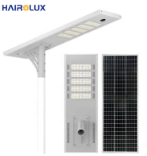
Integrated solar street lights,
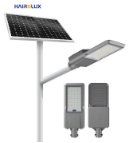
Split-type solar street lights,
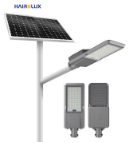
Smart street lights featuring a solar-grid hybrid system.
Today we'll discuss the advantages and disadvantages of each type, helping you select the most suitable solar street light model based on your specific needs and budget.
|
Item |
Integrated solar street lights |
Split-type solar street lights |
Smart street lights featuring a solar-grid hybrid system |
|
Photo |
|
|
|
|
Key Parts |
Photovoltaic panels, |
Photovoltaic panels, |
Dual-system: Includes a solar power generation system |
|
Advantage |
1. Minimal installation: Simply mount the pole and connect the wiring like a standard streetlight—no additional wiring required. |
1. Flexible configuration: Expandable photovoltaic panel and battery capacity for enhanced power output and extended runtime. |
1. 100% Lighting Guarantee: Completely solves power shortages during prolonged rainy periods. |
|
Disadvantage |
1. Power limitations: Constrained by the size of the lamp housing and heat dissipation capabilities. |
1. Complex installation: Requires separate mounting of solar panels and battery boxes, with significant wiring effort. |
1. Highest cost: Incorporates two systems, making it the most complex in structure. |
|
Application |
Courtyards, residential walkways, park |
Medium-to-high power, high-demand scenarios: |
Critical scenarios demanding extremely high reliability: such as |
Summary and Selection Recommendations
Choose the [Integrated Type] if:
Requirement: Basic lighting where “any illumination suffices,” prioritizing minimal installation and aesthetics.
Scenario: Secondary roads or landscape lighting with low illuminance requirements.
Key Selling Points: “Installs as easily as a standard light fixture, zero electricity costs, and visually appealing.”
Select the [Split-Type] if:
Requirement: Pursue high brightness, long endurance, and high reliability—the mainstream choice for solar streetlight projects.
Scenario: Most roads, plazas, and parking lots requiring stable lighting.
Key selling points: “High power, long-lasting brightness, and easy ground-level battery maintenance—the preferred solution for professional projects.”
Choose [Hybrid Type] if:
Requirement: Absolutely no downtime allowed, maximized energy savings desired, and sufficient budget available.
Scenario: Urban roads, critical campuses, smart city projects.
Key selling points: “Solar power during sunny days, automatic switch to grid power during cloudy/rainy days, 100% lighting guarantee—the ultimate solution for smart streetlights.”

 EN
EN