
 EN
EN



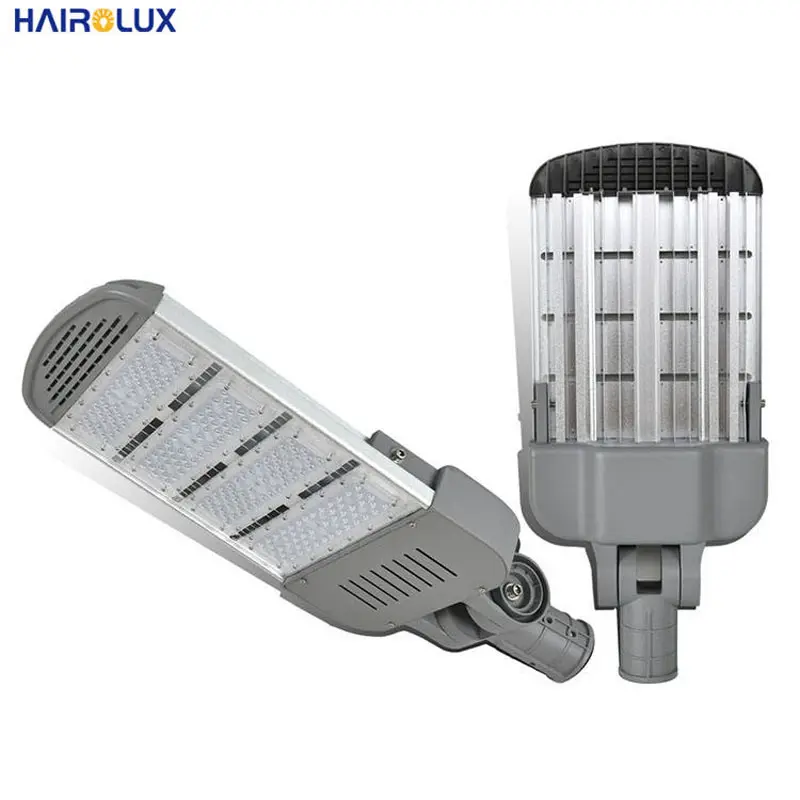
Why Your High-Power LED Street Lamp Runs Hot — and the Cooling Design That Fixes It
A 120W LED street lamp converts approximately 35–40% of input electrical power into light and 60–65% into heat — roughly 72–78 watts of thermal energy that must be transferred from the LED junction to the ambient air continuously for 12 hours every night, 365 nights per year, for a decade. If that heat accumulates at the LED junction faster than the luminaire housing can dissipate it, the junction temperature rises above the critical 85°C threshold — the point at which LED lumen depreciation accelerates from a gradual decline of 3–5% per 10,000 hours to a catastrophic 20–30% loss over the same period, and the LED street lamp that was rated for 50,000 hours L70 reaches L70 in 20,000 hours instead.
The heat-dissipation chain in an LED street lamp has four links, and the weakest link determines the junction temperature. Link 1: the thermal interface between the LED chip and the metal-core printed circuit board (MCPCB) — a solder joint or thermal adhesive layer approximately 50–100 microns thick that must transfer heat with minimal thermal resistance (below 1.5°C/W for high-power applications). Link 2: the interface between the MCPCB and the aluminum heatsink — typically a thermal grease or thermal pad layer that fills microscopic air gaps between the two surfaces, because air is a 10,000× worse thermal conductor than aluminum. Link 3: the aluminum heatsink itself — the die-cast housing with integrated fins that increases the surface area exposed to ambient air by a factor of 10–20× compared to a flat surface of the same footprint. Link 4: passive convection — the natural airflow over the heatsink fins driven by the temperature difference between the hot fin surface and the cooler ambient air. No fans, no pumps — the LED street lamp must dissipate 78 watts of heat silently and without moving parts, because any mechanical cooling device introduces a failure point that will fail before the LEDs do.
HAIROLUX, a national high-tech enterprise with 13+ years of LED outdoor lighting manufacturing, designs LED street lamp housings from die-cast aluminum with optimized fin geometry — the fin spacing, height, and thickness are calculated for the specific wattage range (30W–120W for solar LED street lamps, up to 150W for grid-powered LED street lamps) to balance thermal performance with structural rigidity, weight, and resistance to wind-loading on the pole.
Design Elements That Make or Break Cooling Performance
The fin geometry on an LED street lamp housing must balance three competing requirements. Wider fin spacing (8–12 mm between fins) improves passive convection because air flows more freely between fins, but reduces the total fin surface area available for heat transfer. Narrower spacing (4–6 mm) increases surface area but restricts airflow, and the resulting heat buildup in the narrow channels can actually increase junction temperature despite the larger surface area — a counterintuitive result confirmed by thermal simulation. HAIROLUX's die-cast aluminum LED street lamp housings use optimized fin spacing validated by thermal simulation for each product's wattage range, with the housing acting as both the structural enclosure (IP65/IP66 sealed against moisture) and the primary heat sink — a dual-function design that eliminates the separate heatsink-to-housing thermal interface that would add thermal resistance.
Real-World Application: A Middle Eastern Highway's Thermal Survival Test
A highway lighting project in Saudi Arabia specified 150W LED street lamp fixtures on 12-meter poles along a desert highway where summer ambient temperatures regularly exceed 45°C during the day and remain above 35°C at night — conditions that drastically reduce the passive convection cooling available to an LED street lamp because the temperature difference between the heatsink and ambient air shrinks from ~50°C (in 25°C ambient) to ~25°C (in 45°C ambient). The project initially installed LED street lamps from a supplier without thermal validation for high-ambient operation — within 18 months, lumen output had degraded by 25–30%, falling below the highway's minimum illuminance standard.
The authority replaced the failed LED street lamp units with HAIROLUX fixtures specifically engineered for high-ambient environments: increased fin surface area (deeper fins, extended housing length), a higher-performance thermal interface material between the MCPCB and heatsink, and LED drivers rated for 70°C ambient operation rather than the standard 50°C. After 3 years of operation in the same desert conditions, lumen depreciation measured at 8% — within the projected L70 trajectory for 50,000+ hours. The HAIROLUX LED street lamp's thermal design proved that high-ambient operation is solvable through engineering, not an inherent limitation of LED technology.
Frequently Asked Questions
What is the maximum safe LED junction temperature?
85°C is the industry-standard maximum junction temperature for long-life LED street lamp operation. Above 85°C, lumen depreciation accelerates non-linearly. At 105°C, an LED rated for 50,000 hours L70 may reach L70 in as few as 15,000 hours. HAIROLUX designs LED street lamp thermal systems to maintain junction temperatures below 80°C under worst-case ambient conditions.
Why use aluminum for LED street lamp housings?
Aluminum has a thermal conductivity of approximately 200 W/m·K — roughly 800× better than plastic (0.25 W/m·K) and 5× better than steel (40 W/m·K). Die-cast aluminum also provides structural strength, corrosion resistance, and full recyclability. HAIROLUX LED street lamp housings are die-cast aluminum with integrated heat-dissipation fins.
Can active cooling (fans) extend LED street lamp life?
Active cooling lowers junction temperature in the short term but introduces a fan with a typical lifespan of 30,000–50,000 hours — shorter than the LED street lamp's 50,000+ hour rating. When the fan fails, the LED junction temperature spikes and the LEDs degrade rapidly. Passive cooling (heatsink + natural convection) has zero moving parts and zero failure modes — the preferred design for LED street lamp longevity.
How does dust accumulation affect LED street lamp cooling?
Dust on the heatsink fins acts as an insulating layer, reducing heat transfer to ambient air by 5–15% depending on accumulation thickness. Self-cleaning fin designs — fins angled downward with smooth surfaces — reduce dust retention compared to horizontal surfaces. HAIROLUX's fin geometry considers both thermal performance and contamination resistance.
Does the LED street lamp's IP rating affect cooling?
Higher IP ratings (IP66 vs. IP65) provide better moisture and dust protection but can restrict internal airflow, trapping heat inside the sealed housing. The optimal design balances sealing (for environmental protection) with thermal conduction paths that bypass the sealed volume — heat travels through the housing wall via conduction, not through the sealed air cavity via convection. HAIROLUX's IP65/IP66 LED street lamp designs use this conduction-path approach.
How do I verify an LED street lamp's thermal performance?
Request the manufacturer's thermal simulation report showing junction temperature at the project's maximum ambient temperature, not at 25°C lab conditions. Request LM-80 test data for the specific LED model used, and TM-21 projections that incorporate the luminaire's actual in-situ junction temperature (not the LED manufacturer's ideal-condition temperature). HAIROLUX provides thermal documentation with project quotations.